Singing a lullaby is a tactic often used to help infants fall asleep or to soothe them from an agitated state. Some examples of popular songs learned by many young parents include:
- The Wheels on the Bus
- The Itsy-Bitsy Spider
- Old McDonald Had a Farm
- Patty Cake
- Head, shoulders, knees, and toes …
These songs involve repetition, melody, learning, and even physical activity. Parents and educators use music because it enhances learning.
Imagine you come across a song that you enjoy. Did you learn it with the first hearing, or did you have to listen intently with multiple repeats before mastery? The latter will be true for children with at least some of the songs they enjoy. That focus to memorize applied to music can likewise be deployed in other academic pursuits.
Motor skills and language acquisition happen when pointing to different body parts or repeating different farm animals’ sounds singing Head, shoulders…or Old McDonald. Understanding how water displaces the itsy spider helps with reasoning.
There are tracks that pump you up before a competition or spur everyone onto the dance floor during a party. There are other tunes that are better for studying, relaxing or calming down. When you watch a movie or a content video, there might be a track to cue the beginning or the end of a section. Learning music with other musicians gets you into a routine among a community.
To summarize, music helps adults (and likewise children) with:
- Memorization and focus
- Motor skills
- Language
- Reasoning
- Emotions and confidence
- Routines and community
In a classroom setting, music could be used to:
- signal an upcoming activity
- promote discipline
- grab attention
- stimulates left brain development through creativity
Singing or playing an instrument helps tune and develop motor skills. In more advanced stages, when writing (or interpreting) lyrics, music helps with communication, expression, and mood setting. Approaching mastery is a confidence booster. Collaborating with other musicians teaches teamwork and responsibility while promoting community.
When doing something enjoyable, it is more play than it is work
When you enjoy something, it is easier to work hard at it with patience. With music, eventually you get to choose which genre best matches your interest. During that journey of self-discovery, you get exposure to different styles and culture. Studies show that children who engage in music lessons do better in other areas of academics. The benefits of introducing children to music at a young age are well-documented, encompassing cognitive, emotional, and social development.
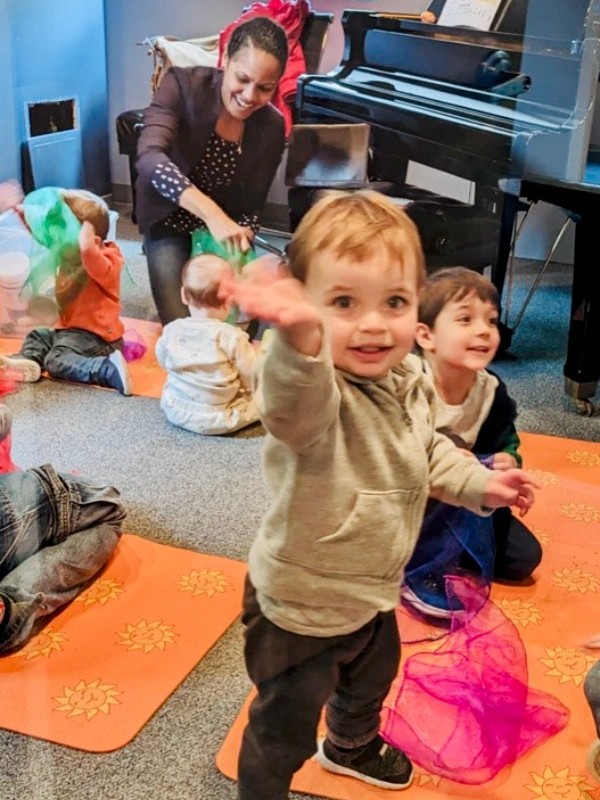
The pop star Prince wrote a song titled “Joy in Repetition”. Music has patterns and sequences. Learning to recognize, repeat, anticipate, and then vary patterns helps cognitive development. At Music in Chappaqua, we encourage children to express themselves through music and movement. In our “Mommy and Me” classes, we introduce the children to music through songs they will love.